
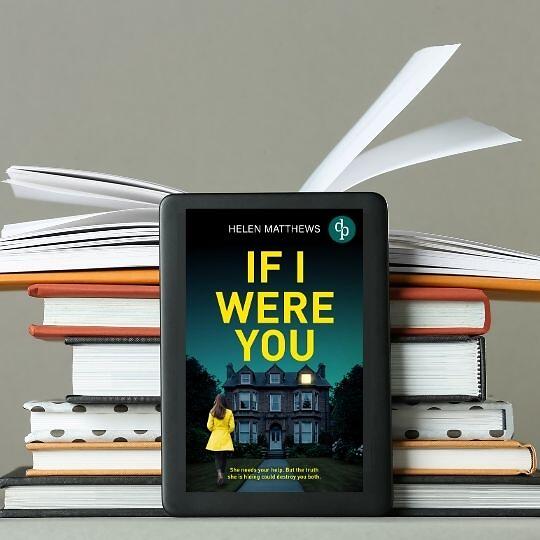
What is your book If I Were You about?
Three years ago, sisters Tessa and Maddie lost contact after a fight at their mum’s funeral. Now Tessa is struggling with an illness that has damaged her perfect life and destroyed her successful career. Her marriage to Adam is shaky and she fears they might never have the family they’d planned.
Then estranged sister Maddie turns up on Tessa’s doorstep with a baby in her arms. Maddie tells Tessa she‘s run away from a violent, coercive relationship. She says she and baby Leon are in danger and begs her sister to let them hide out for a while.
Maddie’s story is full of inconsistencies. Adam presses her to report her abusive partner to the police and is sceptical when she refuses. The next day, Maddie seems to have changed her mind. She asks Tessa to look after Leon for a couple of hours, saying she has a meeting with a solicitor. She never returns …
Now Tessa must deal with grief and anxiety for her sister, while battling her own illness and caring for baby Leon. When the police trail goes cold, Tessa realises no one else is looking for Maddie and sets out on her own investigation with life-threatening consequences.
How would you describe your novel in six words or less?
Gone Girl meets The Handmaid’s Tale
What first inspired the idea of If I Were You?
I’m fascinated by the idea of a life swap. I don’t mean those staged for reality TV shows where couples from different backgrounds exchange homes and act out their new lives like a freak show hyped up for an audience. I’m thinking about quirks of fate that happen in real life where a death or tragedy means another family member must step in and take over a parent or sister’s role. How many of us would be equal to that challenge? What would you (or I) do? And how well do we really know those closest to us?
Tessa is dealing with long Covid and depression in the novel. How did you approach researching and writing her character?
After the Covid pandemic, there was a view among publishers and some authors that people didn’t want to be reminded of the horrors of lockdown and those times. They wanted to put that experience in a box and move swiftly on.
Sadly, not everyone has been able to do that. Healthy people of all ages have been left with lasting health damage from the virus, and some have yet to recover. Long Covid is now part of some families’ lives and impacts them and wider society. Instead of pretending this never happened, maybe we should try to understand how it affects them.
The character, Tessa in If I Were You suffered damage to her heart from the virus even though she was young and healthy. She was initially misdiagnosed by her doctor, disbelieved by her husband and, as the novel opens, is about to be sacked from her high-powered job. Tessa’s life has been upended so it’s not surprising she also has reactive depression. (I do know that, in long Covid, depression can also be neurobiological or linked to inflammation but, as the author, I get to decide my character’s diagnosis.) The treatment Tessa’s on is slowly working and the shock of Maddie’s return and being catapulted into caring for baby Leon, cuts through the fog of her depression. Caring for Leon, and trying to solve the mystery of her sister’s disappearance, give her a purpose.
Without giving any spoilers, how did you approach building suspense around uncertainty and trust in this story?
Psychological suspense thrillers differ from police procedurals and action thrillers as they don’t start with murder and mayhem. There’s no body, surrounded by chalk marks, lying on the pavement and no immediate crime for a detective to solve. Instead, it’s all about atmosphere, uncertainty and building tension through creating a sense of unease. Small clues show that everything is not as it seems and build up into a breadcrumb trail for the reader to follow along with the characters.
When Maddie disappears, neither her sister, Tessa, the investigating police officers, nor readers have any idea what’s happened. Has she been tracked down by Zak, the man she was terrified of? Is her post-partum mental health so fragile she’s ended her life? Has she had an accident? Has someone kidnapped or killed her? The pace picks up and there’s a turning point, similar to Gone Girl, where the believable world of the novel shifts so that readers are a step ahead of the characters in knowing what’s really going on. If readers have emotionally connected with the characters the tension they feel should ramp up because they will care about what might happen to them.
If I Were You overlaps with domestic suspense and, in this genre, the jeopardy often comes from a character being under threat in the very place where they should be safe and secure – their home.
How well can any of us know another person?
Not at all. When I’m plotting a novel, the devious thoughts in my own mind surprise me so I don’t see how anyone else could ever fathom them. I enjoy writing about sisters because I am one and I know, even with almost the same upbringing, how our memories of and reactions to childhood events can be totally different.
This isn’t the first novel I’ve written about sisters (I’m obviously obsessed). Before that previous book came out, I said to my sister Fran, “My book is about sisters, but they’re not based on us. But if you think they are, I’m the bad one.” To which she replied, “That’s no surprise – you’ve had a lifetime of practice.”
How do you unwind after writing about dark and emotionally intense topics?
Long walks and adventures with my rescue dog, Homer. Cycling, swimming and singing in a choir. All followed by a well-earned glass of chilled wine.
What are you currently reading and enjoying?
I’m a huge fan of Lisa Jewell’s psychological thrillers. I’ve recently finished her latest novel Don’t Let Him In. It’s a masterclass in writing flawed, unpleasant and horribly manipulative characters (which is something I also love to do) but still keeping readers gripped and enthralled.
What does it feel like to have your book translated into German and French?
I have a connection with both countries so I couldn’t be more thrilled. I speak reasonable French but only basic German. When my children were young, my husband and I impulse-bought a tumbledown farm outbuilding on the west coast of France, thinking it would be easy to turn it into a holiday home (it wasn’t). We eventually rebuilt it, still own it and always visit France four or five times a year.
I love Germany. I have family in Berlin and Lübeck and have visited both cities. When I was on my gap year travels (long ago) these relatives were working in Colombo, Sri Lanka for the Goethe Institute. Their job was to promote the German language and cultural exchange. I stayed with them for a while and had a wonderful time, assisting with cultural events, including visits from top German musicians and artists.