
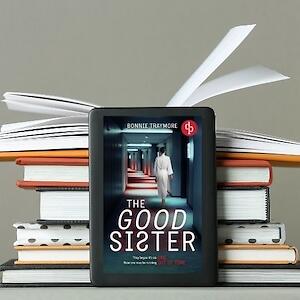
What is your book The Good Sister about?
When her mirror twin goes missing, Casey is led to a deadly paradise where no one escapes…
Casey and Nora are mirror twins, identical—sort of. Casey is right-handed, Nora is left-handed. Their moles sit on opposite cheeks. In terms of personality, they are also diametrically opposed. So, when her high-strung sister disappears after a fight with her husband, Casey shouldn’t be as concerned as she is. Nora’s done it before. Her husband seems nonplussed. But this time, things feel different. It’s a twin thing; Casey knows it in her bones. Something is terribly wrong.
Casey hires private investigator Hank Mercer, and Hank discovers that Nora’s been on the dark web—lured by an entity that calls itself Switzerland, promising to take away your pain and leave you in a state of eternal bliss, for a hefty fee. The trail leads to a luxury wellness retreat hidden in the Mexican jungle. Determined to find her sister before it’s too late, Casey poses as a resort guest and heads to Mexico to rescue her sister. As Casey digs deeper, she finds something far more sinister than she could have imagined, and it’s possible that neither of them will get out alive.
What inspired you to write this story?
My friend that I’ve known since high school has mirror twin sisters, which is how I knew about the concept. I found it fascinating. One is right-handed, one is left-handed. Their faces are like mirror images of each other. Their personalities are opposite. They are in contact daily, even though they live in different states. Then I read up on twin telepathy and twintution, and I thought, what if I wrote a story about mirror twins, and one of them went missing?
Casey and Nora are described as mirror twins with opposite personalities. How did this contrast shape the tension in the story?
The contrast between Casey and Nora was meant to demonstrate that they were two halves of the same whole. Where Casey was detached and pragmatic, Nora was emotional and volatile. I wanted to show their contrasting points of view, but also show how strong the twin bond is between them. How strong? Well, you’ll have to read the book to find out!
The novel features a seemingly perfect place that hides something sinister. How did you develop the atmosphere of this setting?
Two books influenced the resort placement. One was Stephen King’s The Institute, and the other was Liane Moriarty’s Nine Perfect Strangers. I thought I’d combine the two, so on the outside, it looks to the world like a wellness resort, but inside the complex, there’s a place called The Center where all the freaky stuff happens. The setting is original to this book. Because it was mostly set in California, I figured Mexico was a good place to put the resort. Close enough to make it feasible for Casey to go, but in a different country, so it would be harder to intervene, like in the tragic case of the Jonestown Massacre, which is mentioned in the book.
How do you wind down after spending the day immersed in such a tense and suspenseful story world during the writing process?
Good question! I write early in the morning. Very early, when it’s still dark out, before everyone wakes up. It’s when my creativity peaks. Then I work out, then I get on with the business aspect of my writing career. By late afternoon, I’m sacked out on the sofa binge watching my favorite shows on Netflix or a movie. Before bed, I read for an hour or so. Usually a thriller, but sometimes a romance or other genre.
What’s your favorite way to build suspense?
I learned about microtensions from Sarah Pekannen in a class I took with her a while back. These are little conflicts you can put in the scenes to build tension gradually. In psychological and domestic thrillers, they are not as action-based, so the tension needs to build gradually. A strange look. Something that doesn’t seem quite right. A little disagreement in the middle of some otherwise unremarkable dialogue. This builds the tension. Of course, end a chapter with a cliffhanger line.
Where do the ideas for your novels come from?
That is a question I get a lot, and I’m not sure how to answer it. Usually, it’s the seed of an idea or a question, and then it germinates into a story over time. For The Stepfamily, for example, I thought what if a step-mom started to have some freak accidents, but what if they weren’t accidents? Then it grew into a two-book series about a family with dark, twisty secrets. With The Unforgetting, the question was, “Ten years ago, Reagan’s friend died in a tragic accident. But what if it wasn’t an accident?”
Was there a moment while writing that emotionally hit you hard?
Oh, well, in this book, yes. But I can’t say much about it without it being a spoiler. When the ending came to me, it hit me like a gut punch, but I felt it was the right way to end the story. It couldn’t have unfolded any other way. I hope it works for everyone.
What’s currently your favorite genre to read yourself? Do you have any recommendations?
As a reader, I love psychological and domestic thrillers the most, but I also dabble in other genres. For thrillers, Shari Lapena had one of the biggest influences on me, and readers say that my books are like hers, which is a big compliment. There’s nothing like a Freida McFadden binge read to get me out of a slump. More recently, I’ve discovered Alice Feeney and A.R. Torre. They are both excellent. I also recommend anything by Taylor Jenkins Reed or Liane Moriarty. For the art of writing itself, Stephen King.